10 Best Welding Robot Programming Tips to Enhance Efficiency

In today's manufacturing landscape, welding robot programming plays a crucial role in enhancing operational efficiency. Companies seek ways to optimize their processes, reduce waste, and improve productivity. Yet, many face challenges in achieving the desired results.

Efficient welding robot programming requires more than just technical skills. Understanding the unique aspects of each project is essential. Each weld has its specific requirements, and programming must reflect that. Relying solely on generic settings can lead to mistakes. Attention to detail matters; small errors can result in larger issues down the line.

Moreover, it’s vital to continuously assess and refine programming techniques. Sometimes, lessons come from failures. A robot may not perform as expected, and this is where reflection is key. Adjustments based on past experiences empower programmers to enhance future outcomes. By embracing these tips, one can ensure a more streamlined and effective welding robot programming process.

10 Best Welding Robot Programming Tips to Enhance Efficiency

Understanding the Basics of Welding Robots and Their Programming

Welding robots are transforming the manufacturing landscape. They automate tasks and improve accuracy. Understanding their programming is crucial for success. Start with the basics. Familiarize yourself with the machine and software.

Programming often feels intimidating. Many struggle to grasp the language required. Common mistakes include incorrect settings and misunderstanding commands. Testing your programs frequently will help avoid errors later on. A simple oversight can lead to costly downtime.

Hands-on practice can make a big difference. Simulate various welding scenarios to understand their outcomes. Document your experiences and learn from them. Each failed attempt offers valuable insight. Consider seeking feedback from peers. Collaboration can uncover new techniques and enhance your programming skills.


Welding Robot Efficiency Metrics

This chart represents average time metrics associated with welding robot operations, including programming, setup, cycle, downtime, and maintenance. By analyzing these metrics, companies can identify areas for improvement to enhance overall efficiency.

Essential Precautions for Safe Welding Robot Operations

Welding robots are crucial in modern manufacturing. However, safety must always come first. The American National Standards Institute (ANSI) states that improper robotic welding operations can lead to severe injuries. It emphasizes the importance of regular safety training for operators to prevent accidents.

When programming welding robots, ensure that all safety protocols are followed. Each robot should have an emergency stop button easily accessible. Regular maintenance checks are vital, and sensors should be calibrated frequently to minimize risks. A study from the International Federation of Robotics highlights that 29% of workplace injuries in automation are due to machine-human interaction flaws. Therefore, a thorough understanding of the workspace is essential.

Moreover, operators must wear appropriate personal protective equipment (PPE). Exposure to harmful fumes and intense light can pose health risks. The Occupational Safety and Health Administration (OSHA) reports that welders are exposed to over 500,000 hazardous fumes annually. It’s vital to evaluate ventilation systems to ensure safe working conditions. Reflecting on these safety measures can significantly impact overall productivity and worker well-being.

Key Techniques for Streamlining Welding Robot Programming

10 Best Welding Robot Programming Tips to Enhance Efficiency

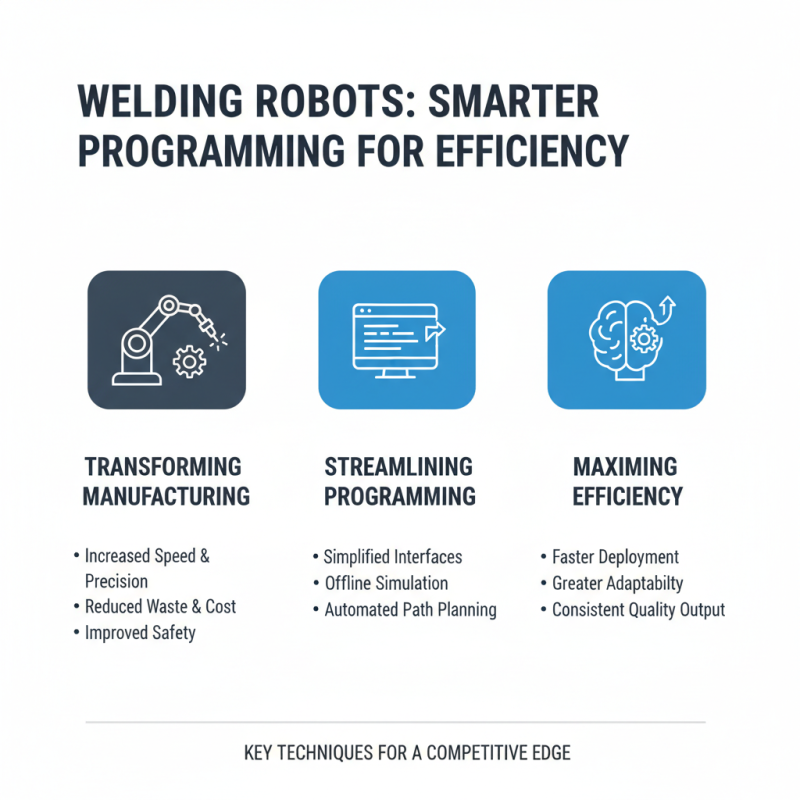
Welding robots are transforming the manufacturing landscape. Streamlining their programming is crucial for maximizing efficiency. Key techniques can make a big difference.

One effective tip is to create a structured programming environment. Organizing your workspace helps minimize errors. Use clear file naming conventions. This approach saves time when searching for programs. Another useful technique is to modularize your code. Break the program into smaller sections. This not only enhances clarity but also makes troubleshooting easier.

Testing your programs regularly is vital. Many users overlook this step. Run simulations to identify issues before actual welding. It’s essential to monitor the robot's performance continuously. This practice helps catch inconsistencies early. Be prepared to adjust your programming based on real-world feedback. Small tweaks can lead to significant improvements over time.

Optimizing Welding Parameters for Enhanced Performance

Optimizing welding parameters is key to achieving superior weld quality and efficiency. Research shows that correct settings can reduce defects by up to 40%. This can be seen in the choice of wire feed speed, voltage, and amperage. Adjusting these parameters can greatly influence bead appearance and penetration depth. For example, a slight increase in voltage may improve arc stability but could risk over-exposure.

Moreover, the shielding gas composition affects welding outcomes significantly. A report from industry analysts indicates that a proper mix can enhance penetration and reduce spatter. Each welding application may require a unique blend. Over time, many operators overlook tweaking these settings due to time constraints, leading to stale practices. It’s crucial to regularly review these parameters to avoid maintaining less-than-optimal conditions.

While some techniques can boost efficiency, a reflective approach is equally important. Continuous training in adjusting welding parameters can prevent complacency. Oftentimes, operators become too comfortable with their routines, leading to missed improvements. Regular assessments and willingness to adapt can unveil hidden efficiencies, elevating the overall welding process. Keeping a flexible mindset will allow teams to navigate challenges more effectively.

10 Best Welding Robot Programming Tips to Enhance Efficiency

Tip No. Welding Parameter Recommended Settings Impact on Efficiency
1 Current (A) 200-250 A Improves penetration and speed
2 Voltage (V) 20-30 V Enhances arc stability
3 Travel Speed (IPM) 12-20 IPM Optimizes weld bead appearance
4 Wire Feed Speed (IPM) 300-400 IPM Improves filler material efficiency
5 Torch Angle (degrees) 15-30 degrees Enhances joint penetration
6 Protective Gas Flow Rate (CFH) 25-35 CFH Improves arc quality
7 Distance from Workpiece (inches) 1-2 inches Prevents burn-through
8 Cooling Rate (°C/s) Controlled Reduces warping
9 Welding Pattern Weave or Stringer Affects bead shape and strength
10 Preheating Temperature (°C) 100-150 °C Enhances material properties

Best Practices for Troubleshooting and Maintenance in Welding Robots

Troubleshooting welding robots can be a complex task. Regular maintenance is vital. A clean workspace helps prevent errors during welding. Dust and debris can interfere with sensors. Inspect cables and connectors often. Look for wear and tear that might impact performance.

Monitoring software updates is essential. Outdated software can lead to inefficiencies. Consider scheduling regular checks. It’s easy to overlook this routine. Robot settings should be reviewed frequently. Small adjustments can improve precision and speed. Ignoring these factors may result in significant downtime.

Be aware of common issues. Misalignment is a frequent problem. It can occur due to wear of mechanical parts. Regular calibration can minimize this risk. Operators should document any recurring glitches. This information is invaluable for preemptive maintenance. Reflecting on past errors can lead to better practices. It’s a continuous learning process.

CONTACT INROTECH SPAREPART

CONTACT INROTECH SERVICE SUPPORT

DOWNLOAD FREE E-BOOK
Download our free Inrotech-Vertigo brochure
Sign up to know more

Download your free Industry E-BOOK

Download your free Inrotech Leaflet

CAREER IN INROTECH?

Download your free Inrotech Leaflet

DOWNLOAD INROTECH-cRAWLER BROCHURE

Download your free Inrotech Leaflet

Book virtual meeting